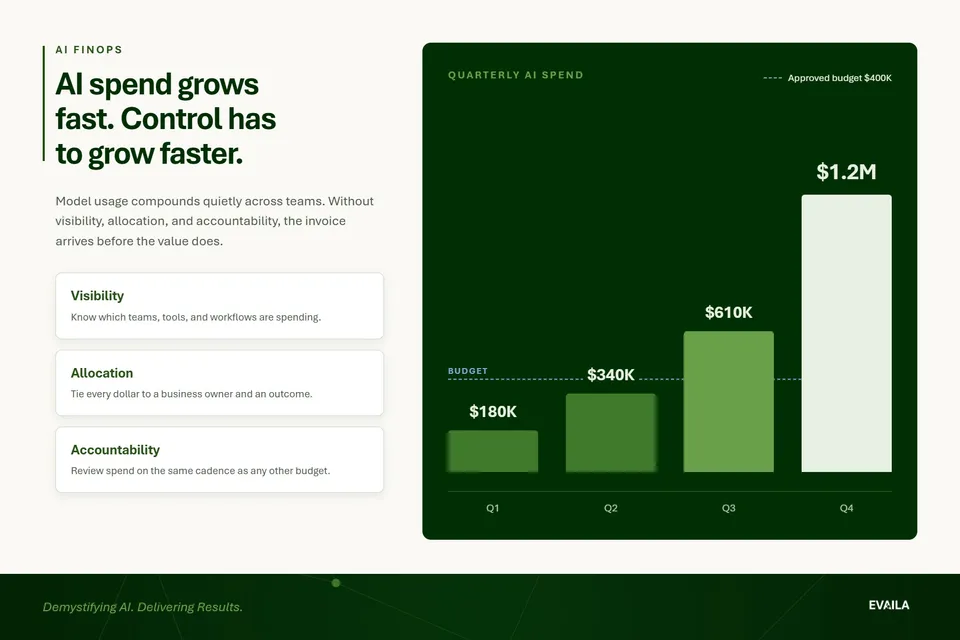
TL;DR: AI spend is climbing because usage is outpacing every budget model built for it, and the fix is not a tighter cap. It is a clear view of the work AI is doing and the outcomes it should produce, defined before the budget is ever set.
You cannot manage the cost of AI until you can name the work it is doing and the value that work is supposed to create.
AI cost management has moved from a back-office concern to a boardroom one. Two years ago, roughly a third of FinOps practitioners were tracking AI spend. Today nearly all of them are. The budget stories making headlines are coming from software engineering, but the pressure is now shared across every function that has started to adopt AI in earnest.
In her latest for Forbes Technology Council, our founder Emily Lewis-Pinnell looks at why those bills climbed even as the price of AI fell, and what leaders should do about it. The full article is worth reading. Here we want to add the operating-model view: what AI FinOps looks like when you treat it as a readiness and adoption problem, not just a finance one.
The invoice went up because the work changed
The most confusing part of the current moment is that AI got cheaper. Cost per token fell across much of the market. And yet the invoices grew.
The reason is simple once you separate the two variables. Total spend is price multiplied by volume, and only the price was falling. Volume climbed faster than anyone planned for. Some of that is agents looping through context and tools on their own. Much of it is simpler than that. People are doing more, with heavier tools, than any budget model anticipated. An engineer who used to type the occasional prompt now runs agentic sessions that consume orders of magnitude more.
That is the shift leaders need to internalize. AI spend has stopped behaving like a subscription and started behaving like cloud compute. It scales with the work. And AI-assisted work does not scale in a straight line.
Software development is the preview, not the exception
It is tempting to file this under an engineering problem. That would be a mistake. The pattern is not unique to engineering. It is skilled people doing their own work faster, with more capable tools, and consuming far more than anyone forecast.
As AI spreads into marketing, finance, customer support, legal, and operations, the same dynamic follows the people. The question stops being only whether to automate a process. It becomes how much value a team is creating with AI, which roles and activities justify heavier use, and where consumption is growing without a clear return.
The Evaila Lens: This is why we start every engagement with the flow of work, not the tool. Cost is a downstream symptom of how work actually gets done. If you cannot see where AI is being used and what a good outcome looks like in that spot, no budget cap will save you. It will only move the problem somewhere less visible.
Define the work before you set the budget
The cloud era taught most organizations to manage capacity: tagging, rightsizing, commitments, chargeback. AI borrows that playbook, and it should. But the analogy breaks in one important place. A virtual machine hour is predictable. You can forecast and reserve it. AI consumption is not predictable in the same way. The same task can consume wildly different amounts depending on how an agent reasons through it, how much context it pulls in, or how a person chooses to use the tool. More consumption does not reliably mean a better result.
So the first move is not financial. It is definitional. Before you set a limit, look at where AI is being used and decide what a good outcome is. For an automated process, that can be concrete: fewer manual reviews, faster resolution, fewer handoffs, lower error rates. For augmented human work, where some of the fastest-growing spend lives, it is harder and more important. The unit of value may shift from the task to the person, the team, or the workflow.
Then measure cost per outcome, not cost per token. Cost per resolved ticket, per reviewed contract, per completed analysis. That connects spend to work in language finance already speaks. It also exposes a trap: a cheaper model that produces more rework is not cheaper. It only looks cheaper on the line item you happen to be watching.
People and agents need different guardrails
One operating-model point gets missed in most cost conversations. Agents and people do not need the same controls.
Agents need hard limits: caps on steps, spend per task, runtime, context size, and tool access. They also need human checkpoints before any action that changes a system of record or reaches a customer.
People need a different kind of guardrail: approved tools, clear expectations by role, guidance on when a heavier model is justified, and shared norms for what good usage looks like. Most organizations wrote acceptable-use policies for safety and data. Far fewer wrote them for cost and value, and that gap is exactly where the spend is pouring through.
The Evaila Lens: This is governance and enablement working together, which is the heart of how we approach adoption. Guardrails are not there to slow people down. They make it safe to say yes to AI without losing control of the bill or the risk.
This can start in ninety days
None of this requires a transformation program. It requires operating discipline, and it can start now. Inventory and approve the tools in use in the first thirty days. Stand up attribution and a model-tier policy in the next thirty. Tie spend to value for the highest-use areas in the final thirty. The cadence should include Finance, IT, Security, and the business owners who own the outcomes.
Tooling for AI cost management will improve, and faster than it did for cloud. But tools only do so much. The part no tool solves is judgment: which work should be automated, how heavily people should lean on AI, and what any of it is worth. Those are leadership decisions. The bill is only where the cost becomes visible. It was decided long before it was ever spent.
If your teams are adopting AI faster than your budget model can keep up, the answer is not to clamp down. It is to get clear on the work first. That is where we help leaders start. Take the AI Readiness assessment or reach out, and we will help you map where AI is creating value and where it is quietly leaking spend.
Demystifying AI. Delivering Results.