TL;DR: Almost every AI initiative is either a tool deployment or a process redesign wearing the same name. Only one of them produces the returns leadership was promised.
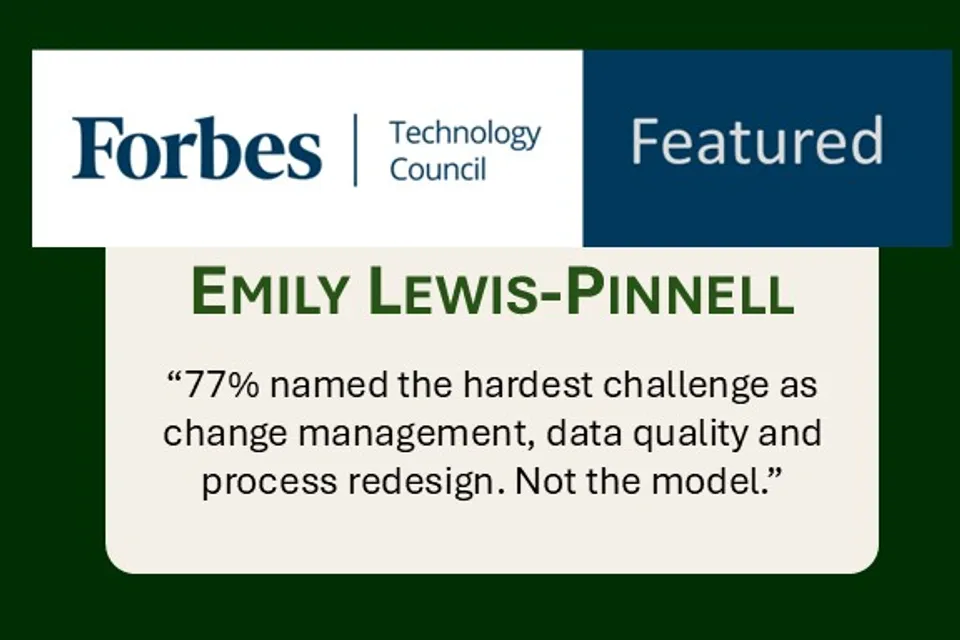
Emily wrote for Forbes Technology Council this month about a Stanford Digital Economy Lab study of 51 AI deployments that delivered measurable value. Two findings stood out. In 42% of those cases the foundation model was fully interchangeable. And 77% of the practitioners involved named change management, data quality and process redesign as the hardest part of the work.
Read that second number again. These are the organizations that succeeded. Even for them, the difficulty sat in the organizational layer, not the technical one.
That creates an uncomfortable question. If the hard part is process and people, why is most of the effort aimed at licenses, models and platforms?
The Two Projects That Look Identical On Paper
Almost every AI initiative we see is one of two things wearing the same name.
The first is a tool deployment. You procure capability, enable it, train people on the interface and measure usage. The workflow underneath stays exactly as it was.
The second is a process redesign that happens to use AI. Steps get removed. Decision rights move. Someone new owns the outcome. The tool is one component of a larger change.
Both show up in the same slide deck. Both get the same green light. Only one of them produces the returns leadership was promised.
AI amplifies whatever process it is applied to. A broken workflow with AI inside it is still a broken workflow, now running faster.
Four Questions That Tell You Which One You Are Running
You do not need an assessment to figure this out. You need honest answers to four questions.
Who owns the outcome once AI enters the workflow? If the only name you can produce is IT, you have a tool deployment. Business ownership is what makes the change stick after the rollout meeting ends.
What steps are you removing? If nothing comes out of the process, AI is sitting alongside the work rather than inside it. Addition without subtraction is how teams end up doing the old job plus a new one.
What do your people do with the time? “They will be more productive” is not an answer. Reps who stop drafting follow-ups need somewhere specific for those hours to go, or the gain quietly dissolves into the day.
Which metric moves, and does anyone already care about it? Adoption dashboards measure the tool. Cycle time, error rate, cost per case and customer contact hours measure the work. If your only metric is usage, you are tracking the wrong variable.
The Evaila Lens: These four questions map to the sequencing we use with clients. Clarify where you actually stand before you buy. Highlight the workflows where AI will matter and be honest about the ones where it will not. Architect the change across people, process and technology together. Ready your teams, which is the phase most organizations skip. Then track outcomes against a real baseline.
Approval Loops Set The Ceiling On Your Return
One finding from the Stanford data deserves its own line item in your planning.
Deployments built on an escalation model, where AI handles the large majority of cases on its own and people review only the exceptions, delivered a 71% median productivity gain. Deployments requiring human approval on every output delivered 30%.
That gap is not a technology gap. It is a governance and process design choice made months earlier. You cannot reach an escalation model inside a workflow built for manual review at every step, no matter how capable the model is. If you have not decided which decisions can move to exception-based oversight, you have already capped your return.
This is also where over-restriction quietly costs you twice. Controls that make the sanctioned path slow do not stop the work. They push it into unmanaged consumer tools where you have no visibility at all. We have written before about what Shadow AI reveals about your workflows and why faster work does not automatically mean easier work.
The Fit Work Is The Real Work
Build cycles keep getting shorter. The work of making something fit an organization has not compressed at the same rate, and it is now the larger share of what determines whether value shows up.
Practically, that means the change management, training and process work should be scoped at the start of the initiative, not requested later when adoption comes in flat. The organizations getting real returns treat process documentation, data architecture and enablement as the actual work rather than overhead layered on top of a technology project.
Read the full piece on Forbes: Why The Model Isn’t The Hard Part, The Workflow Is
If you are not sure which of the two projects your organization is running, that is worth an hour of conversation before the next planning cycle. Let’s talk about making AI work for your business.
Demystifying AI. Delivering Results.