TL;DR: Broad enablement did its job. Most organizations now have AI fluency across the workforce. Agents are a different kind of bet: the unit of value shifts from the task to the workflow, and that shift demands focus, not more access.
The question for leaders is no longer whether people use AI. It’s whether you’ve chosen the one workflow where AI should start acting on its own, and whether you can prove the difference it made.
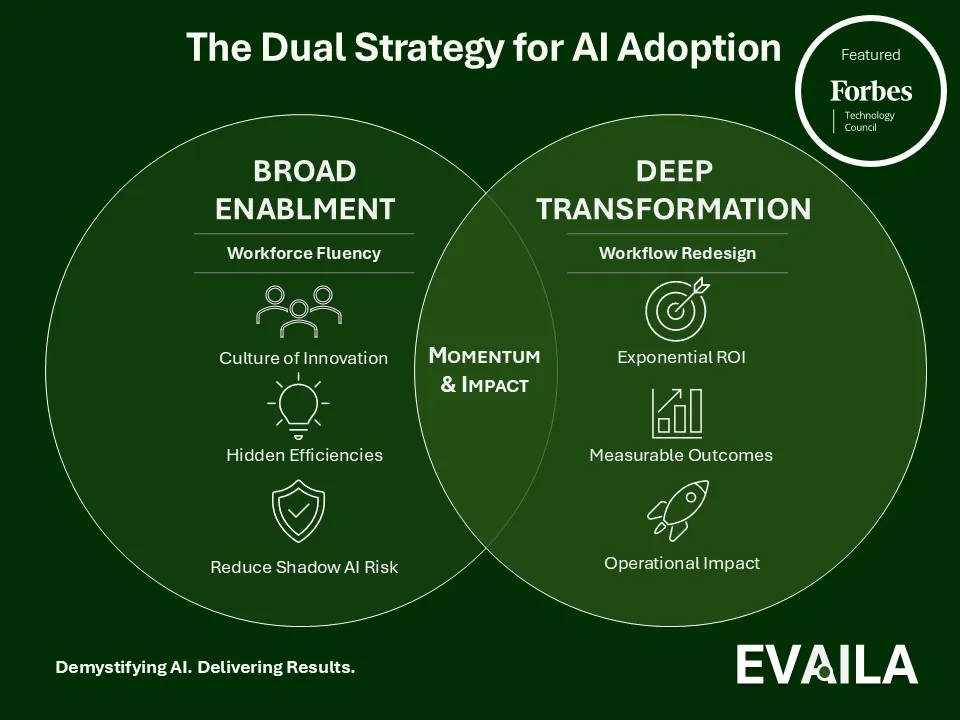
Back in January, we made the case that AI strategy isn’t a choice between broad enablement and deep transformation. It’s both, run as two deliberate tracks. Eight months later, in her latest piece for Forbes Technology Council, Evaila founder Emily Lewis-Pinnell revisits that framework with a sharper question: now that agents are here, which track leads?
Adoption is everywhere. Transformation is still rare.
Stanford’s 2026 AI Index confirms what most leaders already sense: nearly every organization uses AI somewhere. But agent deployment, AI acting on a workflow rather than assisting with a task, remains in the single digits across almost every business function.
That gap is the story. Broad enablement worked. It built the fluency, the comfort, and the shared vocabulary that let a workforce use AI safely. What it didn’t do, and was never going to do on its own, is redesign how work actually flows through a function.
The broad track hit a ceiling
Co-pilots made individuals faster at tasks they already owned. Drafting went quicker. Research took less time. That mattered, and it’s why Going Broad was never a wasted step. But speeding up a task inside an unchanged workflow has a limit, and most organizations have now hit it.
Agents change what’s being optimized. Instead of helping a person complete a task faster, an agent takes a sequence of steps and runs it. The unit of value moves from the task to the end-to-end workflow. That’s a bigger bet, and a different kind of risk: when the output of a task was a draft a person could review, a mistake was cheap. When the output of a workflow is an action, a mistake is not.
The Evaila Lens: This is the shift from the Ready phase of our CHART Framework into Architect. Ready built the fluency and guardrails that make a workforce safe to operate alongside AI. Architect is where we redesign the workflow itself, not bolt an agent onto a process that was never built for one.
Why so many agent projects stall
The failure rate backs this up. Gartner projects that more than 40% of agentic AI projects will be canceled by the end of 2027, not because the technology fails, but because the organization never did the redesign work the technology needed.
Deloitte’s research points to the same gap from a different angle: 48% of organizations have added AI to a function without redesigning the related workflows or roles. Only 12% have redesigned at scale. Most companies are running agents against processes that still assume a human is doing every step, and then are surprised when the results underwhelm.
The measurement problem
Here’s where it gets worse. Many leaders are still judging agent programs with broad-enablement metrics: seats provisioned, logins, training completions. Those numbers tell you whether people have access. They tell you nothing about whether a workflow is actually faster, cleaner, or cheaper than it was before.
Usage is not value. An agent with heavy adoption and no measurable change in cycle time, quality, or outcome hasn’t transformed anything. It’s just a well-used tool.
What focus actually looks like
The Forbes piece lays out a practical path for leaders who are ready to move past fluency:
Keep broad enablement running, but change its job. It’s no longer the end goal. It’s now how you surface candidate workflows, the places where frontline teams already know AI could do more than assist.
Pick one workflow and redesign it end to end. Name an owner. Set one success metric before you deploy, not after. Capture a baseline so “it’s working” means something more than “people are using it.”
Define decision rights before the agent goes live. What can it do alone? What needs a human in the loop? Who owns the outcome when something goes wrong? These answers need to exist before deployment, not get improvised the first time something breaks.
Measure transformation, not usage. Cycle time, quality, and outcomes against your baseline, every time. If you can’t point to a number that moved, you don’t yet have an agent program. You have an agent pilot.
The Evaila Lens: This is exactly where the gap between AI use and AI training becomes dangerous rather than just inefficient. A workforce that never built fluency can’t supervise an agent responsibly. Sequence still matters. You need Ready before you can do Architect well, but Ready is no longer the finish line.
The question has changed
For most of this year, the question leaders asked was whether their people were using AI. That question is largely answered. The real question now is narrower and harder: have you chosen the one workflow where AI should start acting on its own, and can you prove what changed because of it?
That’s a decision, not a rollout. It requires picking, owning, and measuring, the things broad enablement was never designed to do.
If you’re not sure whether your organization is ready to move from enablement to agents, our AI Readiness Assessment is the place to start, because readiness for agents is a different bar than readiness for co-pilots. And our AI Implementation work is built for exactly this: naming the one workflow, redesigning it properly, and proving the result.
Read Emily’s full analysis (Forbes Technology Council): Broad AI Adoption Built Fluency. Agents Demand Focus.
Demystifying AI. Delivering Results.