The Great AI Debate: Broad Enablement or Deep Transformation?
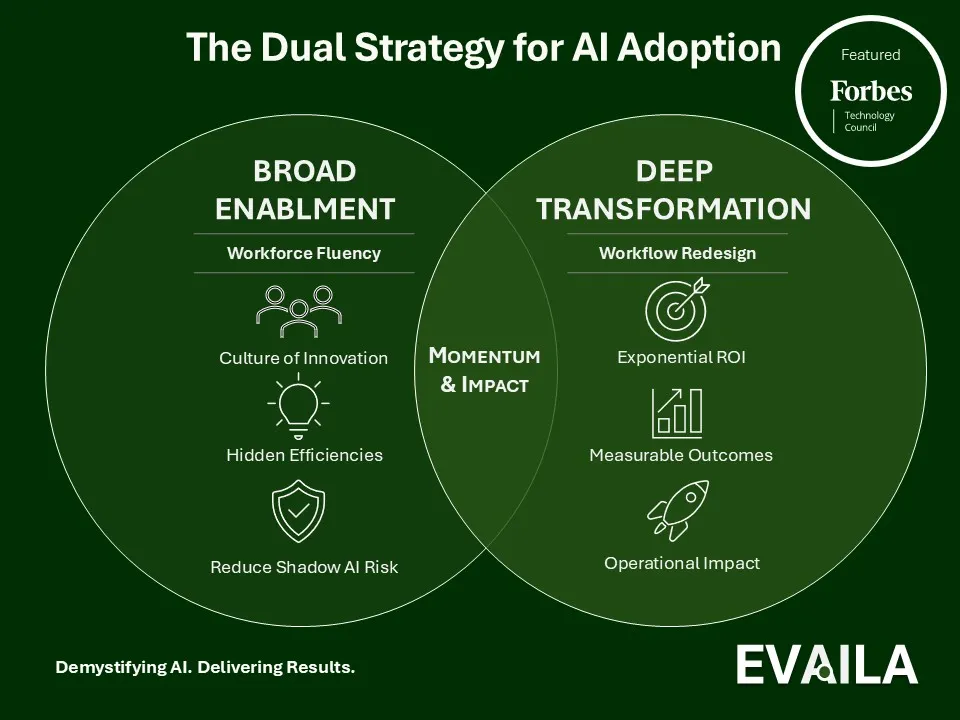
TL;DR: The best AI programs don’t pick a side. Broad enablement builds organizational fluency and surfaces frontline efficiencies. Deep focus redesigns end-to-end workflows so AI delivers measurable outcomes. The winning strategy is doing both, intentionally.
Broad enablement builds fluency. Deep focus delivers outcomes. The leaders who win do both.
If you’ve been leading AI initiatives this year, you’ve probably felt the tension:
- Go broad: train everyone, democratize access, and build a culture of AI fluency.
- Go deep: stop scattering pilots and focus on one domain where AI can materially change outcomes.
It’s easy to see these as competing strategies. But in her Forbes Technology Council article, Evaila founder Emily Lewis-Pinnell makes the case that treating this as an “either/or” choice is the real mistake.
The organizations that scale AI responsibly, and turn it into business results, master the paradox: broad enablement builds capability; deep focus turns that capability into transformation.
Why broad enablement matters
Broad enablement builds organizational fluency: shared confidence and practical know-how that makes AI part of day-to-day work. When more people can safely experiment, you unlock something centralized teams can’t manufacture: frontline discovery. The people closest to the work find “micro-efficiencies” across hundreds of tasks that leadership will never see from the top down.
Broad enablement also addresses a reality most leaders don’t love to admit: if you withhold access, teams may still use AI, just outside approved tools and guardrails. That “Shadow AI” risk (using AI outside policy and protections) isn’t solved by restricting usage; it’s solved by enabling usage safely, with governance and training built in from day one.
But here’s the catch: access alone won’t transform your business.
Why deep focus is where results show up
If broad enablement is how you build momentum, deep focus is how you create measurable outcomes. Deep focus means choosing one domain (a function, workflow, or value chain) and redesigning work end-to-end, rather than stacking disconnected pilots across the organization.
That’s where AI moves beyond “time saved” and into outcomes leaders care about: speed to market, quality, customer experience, revenue growth, and risk reduction. In other words: deep focus is how AI becomes operational, not experimental.
The strategy that wins: Do both
The leaders who scale AI effectively balance exploration and transformation as complementary forces, not opposing ones: broad access builds the muscle; deep focus puts the muscle to work.
Here’s Evaila’s practical take on what that looks like in the real world.
Recommended actions: a “dual strategy” playbook leaders can implement
1) Mandate access, but guide it
Give your teams access to approved tools, then make the path to productive use clear:
- curated use cases by role/function
- internal communities of practice
- training that builds judgment (not just “prompt tips”)
Evaila lens: This is how you reduce risk and accelerate adoption. People don’t need hype. They need confidence, guardrails, and examples that map to their work.
2) Choose one domain to go deep
Don’t try to transform everything at once. Pick a domain where success is realistic:
- strong data signal (even if it’s not “perfect”)
- repeatable processes you can map
- a tech-ready team with an engaged business owner
Then do the work that most pilots avoid:
- map the full task inventory
- decide what should be automated vs. augmented
- redesign the workflow (don’t just bolt on a chatbot)
3) Turn time saved into business value
AI will save time. But time saved doesn’t automatically become value realized. Decide upfront:
- where saved capacity will be reinvested (customers, quality, innovation, upskilling)
- what metrics will prove the value is real
Efficiency is only a win if reclaimed hours are intentionally directed toward high-value growth, innovation, or improved service.
Evaila lens: If you don’t manage this deliberately, “efficiency” becomes slack, and leadership concludes AI “didn’t work,” even when it did.
4) Plan for change management, not just technology
In deep deployments, adoption is the work. Expect to manage:
- mindset shifts
- evolving roles and responsibilities
- trust in outputs and oversight practices
- fear and resistance (explicitly, not silently)
This aligns with our core belief at Evaila: AI isn’t just a tech upgrade, it’s a change in how work gets done. Sustainable results require alignment across people, process, and data, not just deploying a model.
A simple way to start this quarter
If you’re looking for a pragmatic starting point, aim for a dual-track plan:
- Track A (broad): enable safe, guided adoption across the workforce to build fluency and reduce Shadow AI risk.
- Track B (deep): choose one domain to redesign end-to-end and measure outcomes.
That’s how you get both: momentum and impact.
Read Emily’s full analysis (Forbes Technology Council): https://bit.ly/45YZJoJ
Whether you go broad, go deep, or both, the starting point is understanding where your organization stands across data, infrastructure, workforce, and governance. Our Complete Guide to AI Readiness for Business Leaders walks through how to assess readiness before choosing your track.
If you want help building your dual strategy, starting with use case prioritization, readiness, governance, and a rollout plan your team will actually follow, Evaila can help you move from pilots to production, safely and with clarity.
Demystifying AI. Delivering Results.