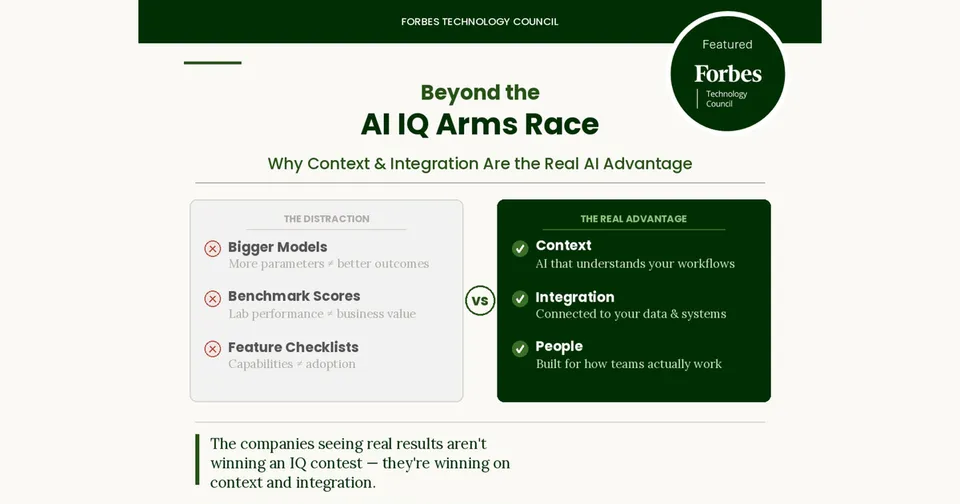
TL;DR: Chasing the best AI model is the wrong race. The organizations seeing real results are the ones building a context strategy, not a shopping list.
“AI shouldn’t arrive like a brilliant intern who forgets everything every morning.”
The Leaderboard Is a Distraction
Every few weeks, a new AI benchmark declares a winner. Reasoning scores. Math performance. Coding speed. The headlines are loud and the vendor marketing is louder.
But here’s what we hear consistently from leaders in the room: the AI tool isn’t the problem. The problem is that the AI doesn’t know who they are.
It doesn’t know their standards. Their approved language. Their compliance requirements. Their workflows. So every conversation starts from zero, outputs are inconsistent, and the productivity gains that looked so promising in the demo never materialize at scale.
This is the context gap. And it’s the real reason so many AI pilots stall.
What “Context” Actually Means for a Business
Context isn’t just giving the AI background information. It’s the organizational layer that makes AI behave like a reliable collaborator instead of a stateless chatbot.
Stored context means AI inherits your brand voice, your compliance boundaries, your process standards, and your institutional knowledge. By default, not by copy-paste. It means an output generated Monday and one generated Friday sound like they came from the same organization.
When that layer is missing, you see the pattern repeat: employees paste the same brand guidelines into every chat session. Teams give contradictory instructions and get contradictory outputs. Sensitive policies live in unmanaged prompts. Compliance risk grows quietly in the background.
That’s not an AI capability problem. That’s an organizational design problem.
Evaila lens: This is why our AI Readiness Assessment surfaces context and governance gaps alongside data and process gaps. The tools your teams choose matter far less than whether you’ve defined what context those tools should always carry.
The Platforms Are Moving Toward Infrastructure, Not Just Chat
My latest piece for Forbes Technology Council tracks a meaningful shift across the major AI platforms: ChatGPT, Claude, Gemini, and Microsoft Copilot are no longer competing primarily on model intelligence. They’re competing on how well their tools fit into enterprise reality: persistent workspaces, reusable instruction layers, grounded retrieval from systems of record, and governed integration paths.
The convergence isn’t accidental. It reflects a shared recognition that intelligence without context and integration doesn’t scale.
What this means for leaders: the decision about which AI platform to use should be evaluated on context architecture and integration fit, not benchmark rankings. How does it connect to the tools where your teams already work? How does it inherit organizational rules without requiring manual setup every session? Can it retrieve from your systems of record rather than relying on what someone remembered to paste in?
These are operational questions, not technical ones. And they belong in the room with functional leaders, not just IT.
A Practical Starting Point
If your teams are getting inconsistent AI outputs, the fix isn’t a different model. Here’s where to start:
Define your core context pack. Brand voice, compliance guardrails, process standards, and approved templates. These should be inherited by default, not re-entered on demand.
Separate universal rules from role-specific guidance. Security and ethics policies apply everywhere. But a finance team prompt needs different guidance than a marketing team prompt. Both layers should exist, and neither should live only in someone’s head.
Connect AI to your systems of record. Stop re-uploading the same files. The platforms are building retrieval capabilities for a reason. Use them so AI works from current, authoritative information.
Treat context maintenance as operational work. Context decays. Guidelines get updated. Business priorities shift. Assign ownership, version your guidance, and audit it like any other operational asset.
None of this requires a dedicated AI team or a six-figure implementation. It requires intentional design, the same discipline you’d bring to any process that your teams depend on to do consistent, quality work.
The Real AI Advantage Is Organizational
Model rankings will keep moving. New capabilities will keep arriving. The benchmarks will keep shouting.
But the organizations that build durable AI advantage won’t be the ones who picked the highest-scoring model in Q1. They’ll be the ones that did the work to make AI show up already aligned to how their business operates.
AI without context is a powerful tool with no instructions. AI with your context is a reliable contributor that scales.
If you want to understand where your context and governance gaps actually are, start with our AI Readiness Assessment. It takes 10 minutes and tells you exactly where to focus.
Demystifying AI. Delivering Results.